
How to Search the Lee County Court Docket
Start with the statewide North Carolina eCourts Portal. Lee County sits inside the eCourts system. Smart Search can pull up a public Case Summary for a record number or a name. The basic public view is free. No registration is needed. Bring the exact record number if you have it, because a name search works far better with a correctly spelled last name plus enough of a first name to thin out similar results.
What the search returns is public information, not a certified file. Open the Lee result, check the location and case type, and then work through the event history and hearing information. For anything on paper, anything sealed, any setting that changes fast, or any official copy, go to the Lee Clerk next. A second web search will not get you there.
- Open Smart Search in the North Carolina eCourts Portal.
- Enter a record number or a party name and submit the search.
- Use Lee County as a location filter when statewide results are broad.
- Open the Case Summary and check the Register of Actions, status, and hearings.
- Use the record number when contacting the Lee Clerk for a copy or confirmation.
Lee County Docket Smart Search
Smart Search needs one core value before anything else. The official Portal guide is clear. A basic search takes either a record number or a name. Advanced Filtering can only refine what a search already finds. It cannot stand alone as the criterion. The same guide warns that a broad search can cut off at 200 results. That cap is a prompt to narrow things by Lee location, case type, case status, or another supported filter, not evidence that a case is missing.
| Portal field | Use in a Lee search | Research note |
|---|---|---|
| Record Number | Direct case lookup | Use the number printed on a court paper or citation. |
| Name | Public party search | Enter the last name first; training advises at least three last-name characters. |
| Location | Result filter | Select Lee County to narrow statewide matches. |
| Search Type | Advanced route | The guide lists case number, citation number, party, business, and attorney choices. |
Lee County docket searches run through the state's online system. The Judicial Branch Portal training material walks through the public search route, which covers Lee County court docket access statewide. One tip from that material stands out.
An account lets you save a case under My Cases. That is all it does. Confidential court material stays off limits either way. The eCourts Portal training resource makes that limit clear.
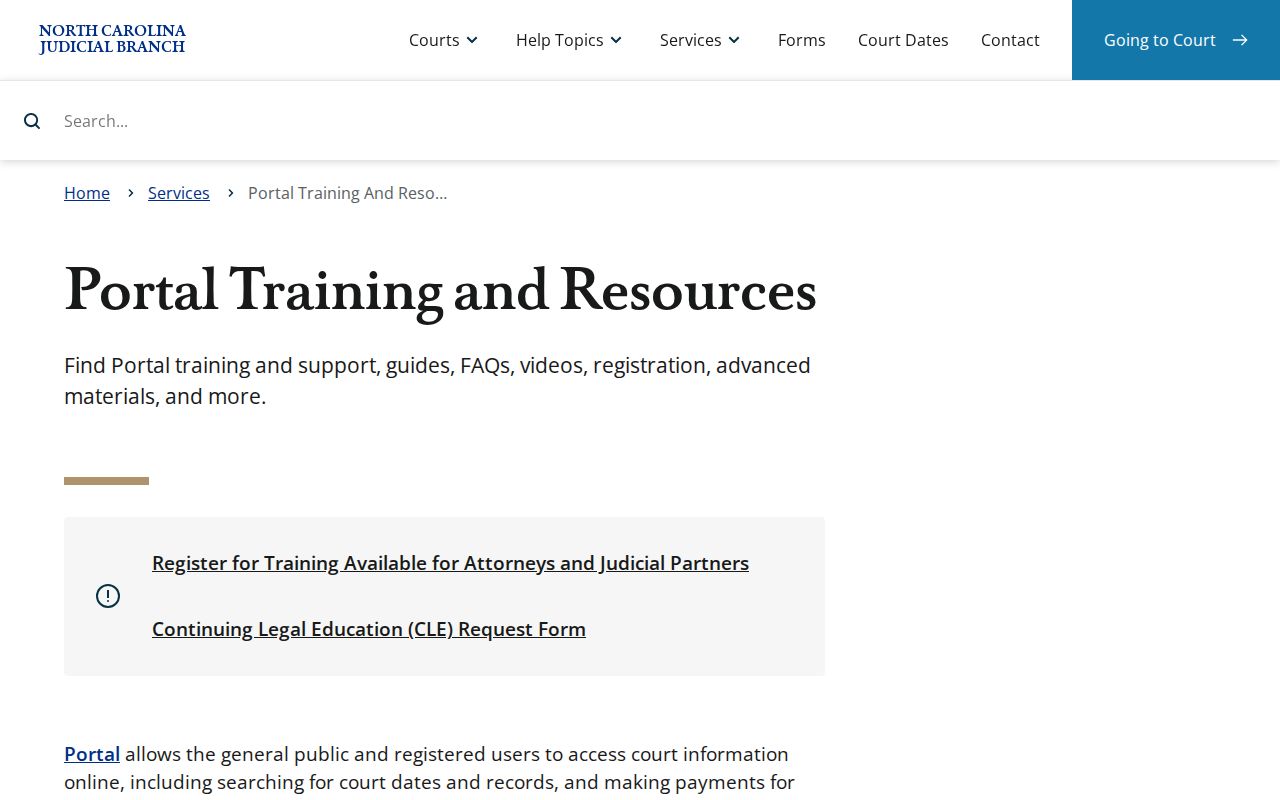
Lee County runs on the statewide Portal, with no separate county-branded case-search database.
What a Lee County Court Docket Shows
Online, North Carolina labels the view a Case Summary or a Register of Actions. The Register of Actions is a chronological event history. It is not a narrative. It is also not automatically the signed document behind an entry. A public Lee County case can display different blocks. That depends on case type and public-access rules. So treat any search result as a set of conditional fields rather than a complete file.
| Record number | The court identifier. The guide describes year, case-type letters, a six-digit sequence, and a county code; use the displayed number. |
|---|---|
| Location and status | Shows where the matter is filed and its procedural position, not a simple outcome label. |
| Parties and assignment | May identify public parties, attorneys, and court assignment where applicable. |
| Events | Dated filings, notices, orders, settings, or other Register of Actions entries. |
| Hearings and financial blocks | Appear where applicable; a visible balance does not itself establish online-payment eligibility. |
| Disposition and documents | May appear where public and processed, but restrictions can remove a document or the case from view. |
Lee County Case Summary Terms
Everyday words carry narrow docket meanings here. A setting is a scheduled court event, never a promise of trial. A disposition is a recorded procedural result, best read alongside its date and related entry. A motion is a request for court action. An order is the court's direction or decision. When the exact terms of an order matter, get the signed or certified record from the Clerk.
- Register of Actions
- The dated event list displayed through the Case Summary.
- Smart Search
- The Portal’s basic lookup by record number or name.
- Search Hearings
- A separate Portal function for locating a setting by location, hearing type, date range, and selected relationship.
- Called and Failed
- A Lee local-calendar phrase for a missed setting; current local materials include a reset-related motion.
Lee's Judicial Branch county code is 520. The state guide does not authorize building a record number from that ending. Copy the number exactly as it appears on the citation, notice, court paper, or Portal result.
Which Lee County Courts Keep Dockets
Lee County belongs to North Carolina Judicial District 12 and runs on one county clerk framework. So the real question is usually which trial division heard the matter. It is not which local clerk holds the docket. Superior Court, District Court, magistrates, and clerk special proceedings all play different roles. Through all of it, the Lee County Clerk of Superior Court stays the local records point. That covers the whole trial-court system.
| Court or officer | Lee docket coverage | Public route |
|---|---|---|
| Superior Court | Felonies, higher-value civil matters, and eligible trial-level appeals. | Portal, Lee Clerk, and local schedules when set. |
| District Court | Misdemeanors, infractions, lower-value civil matters, family matters, and traffic. | Portal, Search Hearings, Clerk, and Lee calendars. |
| Magistrates | Specified small claims, eviction-related matters, warrants, bail, and limited proceedings. | Clerk or magistrate framework, subject to public-access rules. |
| Clerk matters | Estates and special proceedings, along with clerk-held trial records. | Lee Clerk, Portal or terminal where public, and paper-file routes where applicable. |
The Superior Court and District Court descriptions cover that division split. Lee has no official county justice court or municipal-court docket database to search instead.
Lee County One-Clerk Docket System
Lee does not split trial files between a district clerk and a county clerk. One elected Clerk of Superior Court performs the court's recordkeeping for both Superior and District Court files, plus estates and special proceedings. That shared structure makes the Clerk the local contact. Use that office when a Portal search leaves a public answer incomplete, when a paper file matters, or when a certified record is required.
G.S. 7A-109 requires the clerk to maintain dockets and indexes. It keeps those listed records open for public inspection during regular office hours unless law prohibits access. The rule is why a clerk counter and public terminal still count. That holds even with online searching available.
The Lee County Courthouse information names the common court location. The Clerk and the local trial divisions use it.
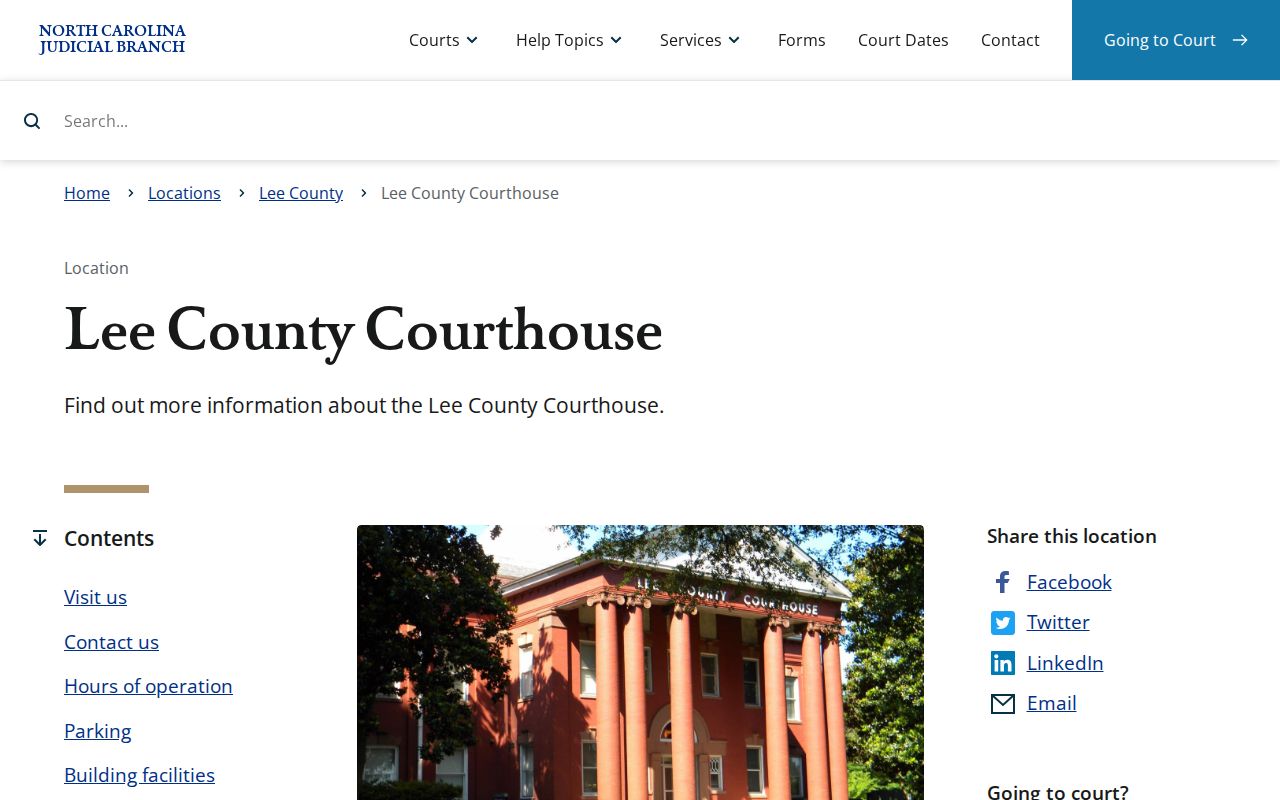
It serves as the shared local destination for court records that need clerk review rather than another online filter.
Finding Lee County Court Dates and Settings
For a specific Lee County setting, begin with the Case Summary and its hearing information. Need a date-range search? The Portal's Search Hearings feature is next. It draws on a Lee location, a hearing type, a search type, and date fields. The official guide permits searches by case number, party, business, attorney, judicial officer, or courtroom. Results are sortable. Still, not every field is promised for every hearing category.
Lee's local administrative schedules add useful calendar context. They cover criminal, civil, domestic, DWI, disposition, and other allocations. A schedule is not a case-specific confirmation. A reset or order can change an appearance. That can happen after a weekly or annual PDF is published. For a time-sensitive question, use the appropriate courtroom or Clerk contact. The dedicated Lee County court calendar page gives the full setting-search sequence.
Lee County 2026 Docket Schedule
Lee's 2026 master schedule takes effect January 1, 2026. Think of it as an allocation guide rather than a room map. The grid pairs weekday labels, A/C and B/D, and those letters should never be turned into invented room assignments. PV/CRIM and Criminal allocations land on several days. People's Court holds the Wednesday A/C slot. Friday carries the IV-D and DWI (DWIC) allocations. Disposition and bond-forfeiture matters are listed for the second Tuesday, and a scheduled one can replace the usual criminal allocation for that day.
Why do these odd labels matter? A Lee County court docket entry may carry a setting tied to one of these specialized calendar categories. That is all the label means. The categories do not create separate specialty courts. For an actual hearing date, the current local schedules page, the individual Case Summary, and a confirmation from the clerk's office form a much stronger sequence than any general weekday grid.
Lee's local administrative schedules page publishes the court's current calendar documents and their related categories.
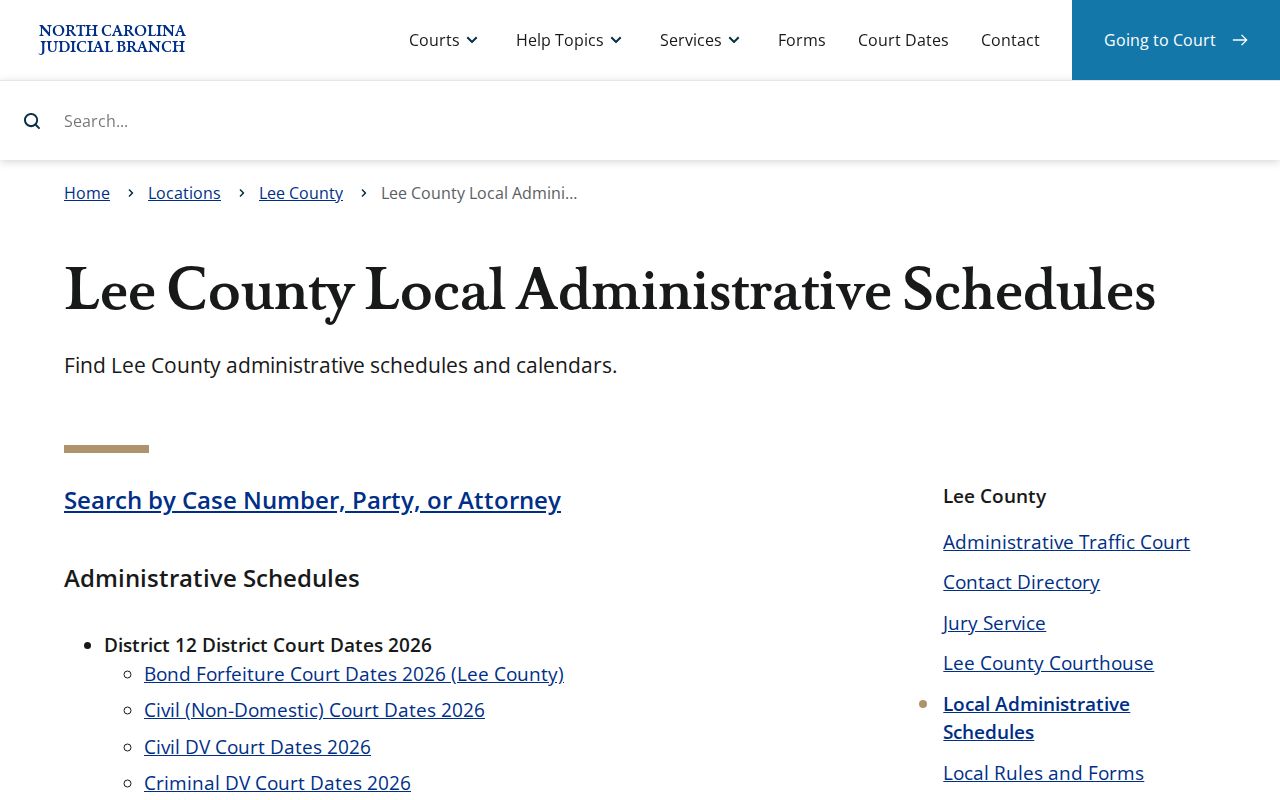
Use the schedule to read Lee County's calendar patterns. The individual docket, not the grid, supplies the case-level setting for your matter.
Public Access to Lee County Court Dockets
Lee treats court records as public unless restricted. That rule is not a promise that every case or image appears in every search. The Portal only mirrors public docket information. It is not the official court record. Clerk inspection, copies, and online access all remain subject to confidentiality statutes, sealing or expunction, redaction, and court orders.
North Carolina court-record rules:
G.S. 7A-109 requires clerk-maintained dockets and provides the baseline inspection rule.
G.S. 132-6.2 addresses copies, actual costs, and the fact that a custodian need not create a new compilation.
G.S. 7B-3000 limits public inspection of juvenile records.
G.S. 7B-2901 makes abuse, neglect, and dependency court records confidential.
Lee County Docket Search Gaps
A blank Portal result proves nothing. It does not mean the case never existed or that the Lee Clerk lacks a file. Check the spelling first. Then check the record-number format, the selected location, and whether the search was narrowed too far. Public data are near real time, but processing can delay a new filing. The Portal guide also warns that a broad search may stop after 200 matches, so the case you want can hide inside an overbroad name search.
Restriction is the other common reason. The public Portal leaves out confidential and restricted information. Its FAQ gives juvenile cases, protective orders, and unreturned criminal warrants as examples, and sealed or expunged material never comes back to ordinary public users. Do not hunt for a workaround. If a person is authorized to request the record, ask the Lee Clerk which lawful access procedure applies.
Note: A free Portal account saves public cases. It adds no elevated access to restricted Lee County docket material.
The Lee County Clerk and Docket Records
The Lee County Clerk of Superior Court holds the trial-court files. That office is the authority. The online Case Summary helps you locate a record number, watch public events, and spot a hearing. Need a paper file, a plain copy, or certification? The Clerk is the route. The office can also help when a public record will not resolve online. When you make a request, give the Lee record number, the court division, the exact document or event, and whether you need an ordinary or certified copy.
Lee County Clerk of Superior Court
Lee County Courthouse
1400 S. Horner Blvd.
Sanford, NC 27330
919-718-6300
The courthouse page lists regular public hours of 8:00 a.m. to 5:00 p.m. on weekdays. Clerk offices also offer public terminals. The state recognizes those terminals as an access channel. The NCAOC public-records form covers administrative records held by that office, not a Lee case-file copy request.
Lee County Official Docket Copies
A Portal result and an official copy do different jobs. The Register of Actions can flag a filing or a case status, but printing a screen does not create an authenticated document. Want the record behind an entry? Contact the Lee Clerk with the case number and a description of the document. The Clerk can say whether inspection, an ordinary copy, certification, a certificate under seal, or another route fits. The state fee chart took effect January 1, 2025. A certificate under seal costs $3. An exemplification costs $10. Ordinary copies run $2 for the first page plus $0.25 for each additional page. A record or docket document runs $6 for the first page. Each additional page adds $0.25. A criminal record search costs $25. These are statewide chart figures, not a promise of the current Lee charge, so confirm the amount and the payment method with the Clerk before ordering.
| Request type | What it provides |
|---|---|
| Case Summary | Public online navigation and event information, not the official record. |
| Plain copy | An ordinary reproduction of a public court item. |
| Certified copy | A Clerk-authenticated court record when certification is needed. |
| NCAOC administrative request | Records held by NCAOC, not Lee Clerk case documents. |
Lee County eCourts Docket History
Lee was an original eCourts pilot county. The Odyssey-based system launched locally on February 13, 2023. That rollout brought the Portal, File & Serve, and an integrated case-management environment into Lee's court process. File & Serve serves authorized electronic filing only. It is not the public case-search route, even though the same conversion delivered both services. North Carolina finished the eCourts conversion across all 100 counties on October 13, 2025. Lee's early pilot date is why a current docket search starts in a statewide system instead of a former county-specific database. The Portal stays a public access view. The Clerk remains the holder of the official court record. The eCourts pilot announcement names Lee as a launch county. It explains the transition to the integrated system.
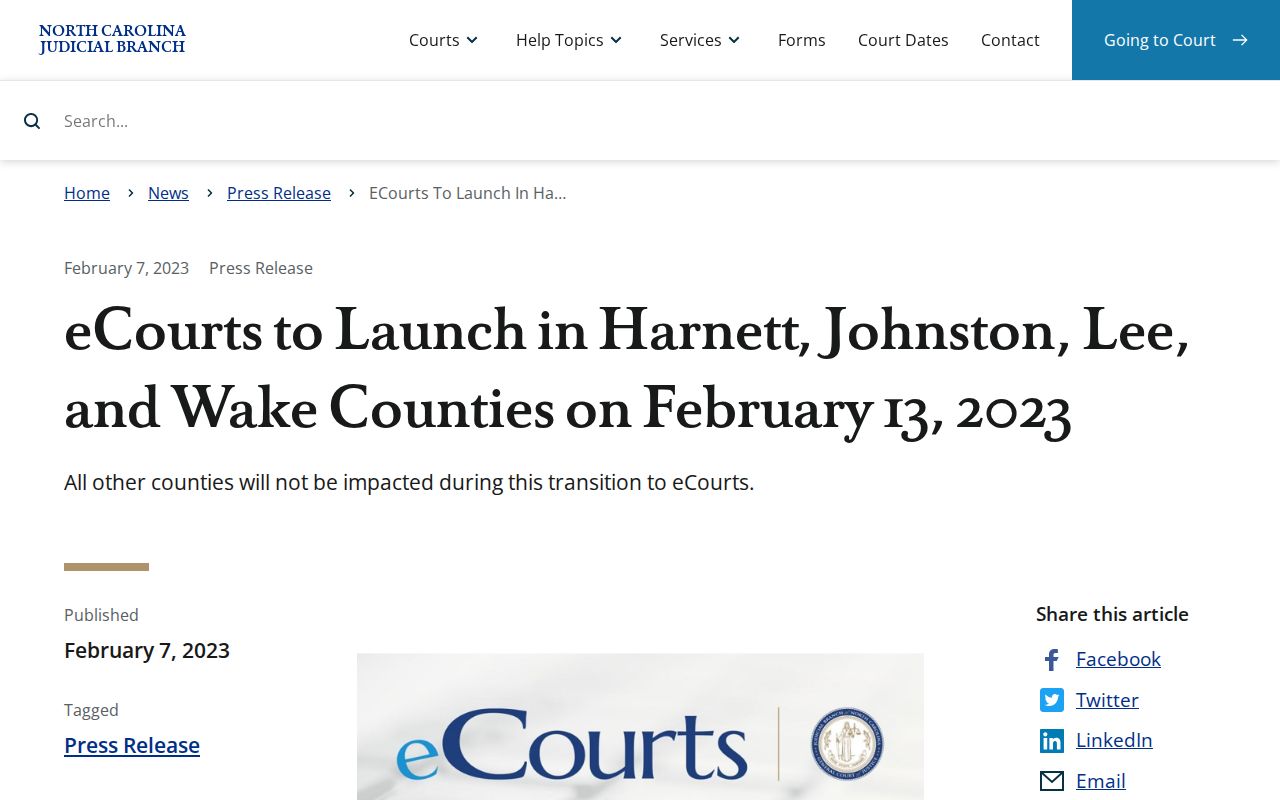
That early conversion is a local reason the Portal now serves Lee County dockets across criminal, civil, traffic, and clerk matters. Old county-specific searching is gone.
Court Dockets by City in Lee County
Lee County holds just two incorporated cities, Sanford and Broadway. The North Carolina Office of State Budget and Management published Vintage 2024 estimates. Those rank them first and second in population. Neither one runs its own municipal court or keeps a separate city docket database. So a citation written in either city, whether a misdemeanor or an ordinance prosecution, lands in Lee District Court. From there, the public case path runs through the Lee Clerk and the eCourts Portal. That is where a Lee County court docket search actually pays off. City Hall and Town Hall still matter. The police departments matter too. They handle local services and enforcement questions. They simply do not hold court records. For a court date, a certified copy, or a Case Summary, the county Clerk is the office to contact. The city pages reflect that split.
Sanford Court Docket
32,813 residents in the July 1, 2024 OSBM estimate. Sanford-origin court matters use the shared Lee District Court, Clerk, and Portal path.
Broadway Court Docket
1,392 residents in the July 1, 2024 OSBM estimate. Broadway has no Town court, so court records follow the same Lee state-court route.
OSBM’s municipal population change table supplies the two-place ranking and the 2024 estimate vintage.
Map and Directions to the Lee County Courthouse
Superior and District Court files, Civil, Criminal, Estates, and Special Proceedings all run through the one Clerk of Superior Court counter at the Lee County Courthouse in Sanford. The building also hosts Administrative Traffic (Disposition) Court, which runs 9:00 a.m. to 4:00 p.m. on the scheduled date for minor infractions; it is not a trial, and contesting a citation means appearing there or sending an attorney to get a later officer-present date.
Lee County Courthouse
1400 S. Horner Blvd.
Sanford, NC 27330
919-718-6300
Weekdays, 8:00 a.m. to 5:00 p.m.
Public parking is available on Courtland Drive or Elm Street, and the building lists wheelchair access and vending. The jury pool waits on the second floor. No official source posts an entry-screening policy or a public-terminal room number, so a call to the Clerk before a time-sensitive visit is worthwhile.