
How to Search Criminal Dockets
The North Carolina eCourts Portal is the free public tool for pulling up a Lee criminal or infraction Case Summary. You can search by record number or by name. Results update close to real time. Remember, though, that this view is not the official court record itself. Before trusting the hearing details on a match, check the Lee court location. Also check the parties listed. A case in another county can carry a similar name. When you search by name, have the spelling ready. Or grab the record number if you have it. The portal also offers a Search Hearings function for current settings. Limit it to the Lee location, the Criminal hearing type, and a real date range. Calendars change, so confirm any time-sensitive hearing with the court or clerk before you rely on it.
- Open Smart Search in the eCourts Portal and enter a name or record number.
- Select the returned case that identifies Lee as the court location.
- Review the public Case Summary for status, event entries, and hearing details.
- Use Search Hearings with Lee, Criminal, and a date range for an upcoming setting.
- Contact the Lee Clerk for a paper file, a copy, or a certified record when needed.
Lee County Criminal Docket Search in Smart Search
Smart Search is the public lookup path. It is not eCourts File & Serve, which serves filers rather than searchers. Portal materials describe the Case Summary as the place to review public case information. Registering an account does not lift a public user into restricted records.
The Judicial Branch's Portal training resources walk through the statewide search and its access limits. A broad name search can return several matters. Compare court location, parties, and status to pick the right one. When you need a certified record, give the Lee Clerk the record number. Then ask for the specific item. A portal display is not a certified copy.
For county reporting categories, the statewide criminal and infraction case activity report is the official source. It lists what each county reports.
Those labels are a starting point, nothing more. They cannot replace the detail inside an individual Case Summary for a Lee case.
What a Criminal Docket Shows
What shows up in a public criminal Case Summary? It depends on the case. Fields can include the record number, the Lee court location, parties, case status, event or Register of Actions entries, hearing information, and any financial or disposition blocks. Each field appears only where it applies. A Lee criminal docket may not display a bond amount, an officer name, a charging document image, or the same personal identifiers you would find in another case.
| Record number | The identifying number for the returned Lee case; retain it when asking the clerk for a particular record. |
|---|---|
| Location and parties | Details that help distinguish the correct Lee Case Summary from another result with a similar name. |
| Status | A Portal process label such as Pending, Appealed, Disposed Clerk, Reopened, Stayed, or Trial De Novo. |
| Events | Dated Register of Actions entries that may reflect a filing, notice, motion, hearing, reset, order, or disposition. |
| Hearings and outcome blocks | Future-hearing information and, when applicable, disposition or financial information visible for that public case. |
Lee County Criminal Docket Report Labels
The state's county activity reporting leans on three abbreviations. CRS marks Superior criminal reporting, CR marks District criminal reporting, and IF covers infractions. Treat them as report labels only. They are not a full case-number glossary. Nor do they tell you a charge level. Still, they reflect the separate tracks that sit behind a Lee County criminal docket search.
- CRS
- Superior criminal shorthand in the statewide criminal and infraction activity reports.
- CR
- District criminal shorthand in those reports, which helps distinguish misdemeanor-level criminal reporting.
- IF
- Infraction shorthand in the reports, including the traffic-related path handled in District Court.
Read a Portal status with care. Labels such as Discontinued, Final Judgment No Trial, Trial Judge, Trial Jury, or Transfer mark a process or result category in the interface. They are not plain-language explanations of what actually happened. The underlying record always controls.
Stages on a Criminal Docket
No two criminal cases move alike. Read a Lee docket as a dated record, not a forecast. An early entry might give way to notices, a setting, filings or motions. A hearing that follows may itself get reset. A disposition or post-disposition entry often comes later. An eligible District Court criminal judgment can also trigger a separate process. That process is a Superior Court trial de novo. It is why the court shown on each record matters.
Process line: Filing → Arraignment → Pretrial → Plea or Trial → Disposition → Sentencing
Treat this as a general map. A public Case Summary will not always carry these exact entries, or every stage. For the next action in a specific Lee matter, trust the record number, the event date, and the current hearing information.
Lee County Criminal Docket Calendar Labels
Lee's 2026 local schedule uses focused labels. You may see PV/CRIM, Criminal/District Court, Criminal Domestic Violence, People's Court, DWI (DWIC), probation cause or violation, Disposition, and bond-forfeiture documents. Those names explain why a setting lands under a particular calendar allocation rather than a generic criminal session. They do not mean each label is its own court or a formal specialty program. For how court time is usually divided, the official Lee administrative schedules offer helpful context.
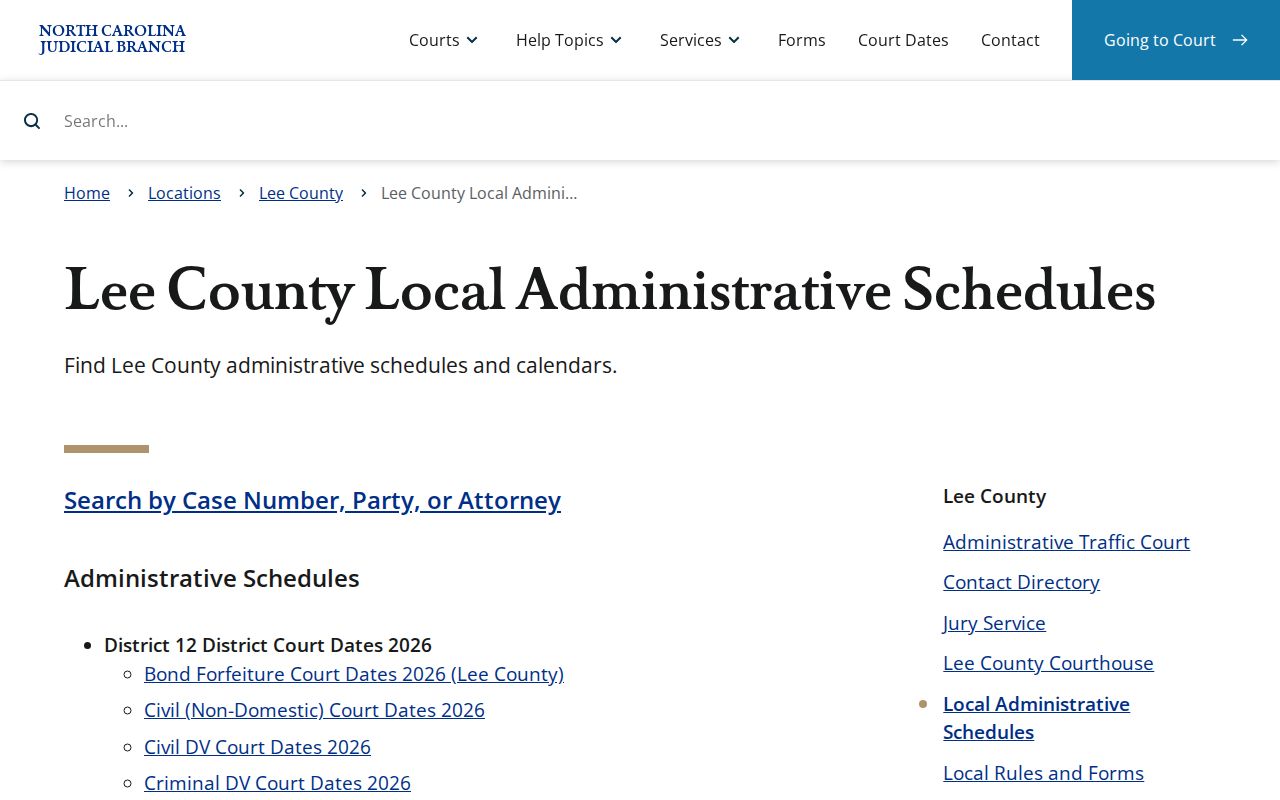
A schedule PDF is not a personal hearing confirmation. The Lee Administrative Traffic Court information spells this out for Disposition Court. It is not a trial, and the officer is not present. Someone who wants to contest must appear, or have counsel appear. That step gets a future officer-present date.
Which Court Holds Criminal Dockets
Lee County runs criminal cases through one unified system. There is no standalone county criminal court. The Lee County Clerk of Superior Court holds the records for both trial divisions. The Portal entries come through the same office. Felonies go to Superior Court. Misdemeanors and infractions, including the traffic path, go to District Court. Magistrates hold only limited roles inside the same General Court of Justice framework.
That division matters when you read a result or track an appeal. Under G.S. 15A-1431, an eligible appeal from a District Court criminal judgment can move to Superior Court for trial de novo. So the original District Court case may deserve a look. The later Superior Court process may deserve one too. The Lee Clerk keeps the court docket records. That means not the District Attorney and not the magistrate office.
When a Lee County Criminal Docket Result Is Missing
A blank result on a Lee County court docket search is rarely a dead end. Check the spelling first. Check the record-number format and the Lee location too. Some matters simply sit outside public Portal view. The Portal FAQ lists juvenile cases, protective orders, and unreturned criminal warrants as unavailable to ordinary public access. An empty result proves nothing about whether a person or case ever existed.
Don't hunt for a workaround to restricted access. A free Portal account grants no elevated privileges. When a known public record stays out of reach, call the Lee Clerk and ask what access process applies. The main number is 919-718-6300. The Lee courthouse is open weekdays from 8 a.m. to 5 p.m. for the documented public-access route.
Public Access and Sealed Criminal Dockets
North Carolina court records are open by default. Access narrows only when a statute, rule, or court order says so. G.S. 7A-109 backs public access to clerk-maintained court records during regular hours. Even so, the online Portal is not the official court record. It will not return confidential or restricted material. A public paper file may exist in the clerk's office. The online case can still show no document image.
Access limits matter.
G.S. 7A-109 establishes the baseline public-access rule for clerk-maintained court records.
G.S. 7B-3000 withholds juvenile files from public inspection except through authorized or court-ordered pathways.
G.S. 7B-2901 makes abuse, neglect, and dependency records confidential.
Lee County Criminal Docket Copies and Case Status
A copied Case Summary from the Portal is not a clerk-certified record. To request a public criminal record, give the Lee Clerk the court and the record number if known. Add enough party information to locate the file. Name the document or event you need, plus whether the copy must be certified. A file not fully available online can still be inspected. Try the clerk's office or its public terminal.
Expunction can remove, seal, or destroy records, depending on the statute. The Judicial Branch's expunction information explains that a petition generally goes to the clerk where the charge or disposition occurred. It notes a $175 petition fee with stated exceptions. It also warns that processing can take months. Eligibility turns on the statute and your history. A dismissal alone does not wipe every record away.
Lee County Criminal Docket Appeal Path
A District Court criminal case and a later Superior Court process are not one continuous docket entry. G.S. 15A-1431 sets the general rule for an eligible appeal from District Court. Notice of appeal goes in within 10 days after entry of judgment. The appeal brings a trial de novo in Superior Court. The later path needs its own record check and its own current setting.
Not every criminal matter gets appealed. A Portal status alone never explains an appellate choice. What the rule does show is why the trial division and the event date both matter. A District Court disposition does not end all docket activity in a Lee County case.
Lee County Criminal Docket Office Roles
The Lee Clerk keeps the court records. It is the practical source for inspecting public files, ordering ordinary copies, and getting certified records. The magistrate office plays limited criminal-process roles involving warrants, bail, and matters permitted by law. It is not a separate county public-docket system. The Lee contact directory lists the magistrate office at 919-718-6319.
The District Attorney prosecutes; it does not keep the docket. Its Lee number in the directory is 919-718-6310. Keeping these offices straight matters. It keeps a searcher from treating a prosecution call or an early magistrate matter as the source of the court's complete case record.
Lee County Criminal Docket State-Court Boundary
A federal criminal case never lands in the Lee Clerk's files. Federal matters belong to the United States District Court system, with its own docket-access channels, including PACER for the Middle District of North Carolina. A police report is different too. It stays a police report even when the underlying case later reaches Lee District or Superior Court.
For a Lee state criminal matter, stay with the eCourts Portal and the Lee Clerk. The court location, record number, and division shown in the Case Summary are your practical signals that the public record sits inside the county's unified state-court framework.