
How to Search Civil Dockets
Most people begin with the free North Carolina eCourts Portal. It updates close to real time. Search by case number if you have one. Otherwise, run a party-name query. Then compare the location, parties, case type, and status that come back. The Portal is not the official record, though, and it will not expose restricted information. For a coming event, open Search Hearings. Set the Lee location, the Civil hearing type, and a date range that makes sense. Need the file itself or a particular copy? The Lee Clerk and the public terminal in the office remain the backup route. File & Serve exists for electronic filing only, not for public civil-docket searching.
- Open Smart Search in the eCourts Portal and enter the record number or party name.
- Choose the returned case that identifies Lee as the court location.
- Review its public Case Summary, events, status, and hearing block.
- Use Search Hearings with Civil and a date range to check a setting.
- Ask the Lee Clerk for a public paper file, a document, or a certified copy.
Lee County Civil Docket Filters in the Portal
One name can pull up several Lee County cases at once. That is why filters matter. The state's advanced guide suggests narrowing by case type. Examples include Civil Foreclosure, Civil General, Civil Magistrate, Confession Judgment, Non-Domestic Restrictive Order, and Summary Ejectment. Those are illustrations only. A given Lee County civil docket search may not offer every option listed.
The Portal works in a set order. You first run a primary name or record query. Then apply a case location, a case type, or a status to split apart similar results. For the official word on these statewide tools, start with the Portal training resources from the Judicial Branch.
Wondering how busy the civil side is? The Judicial Branch also publishes a civil overall caseload activity report that breaks down civil filing activity statewide and by county.
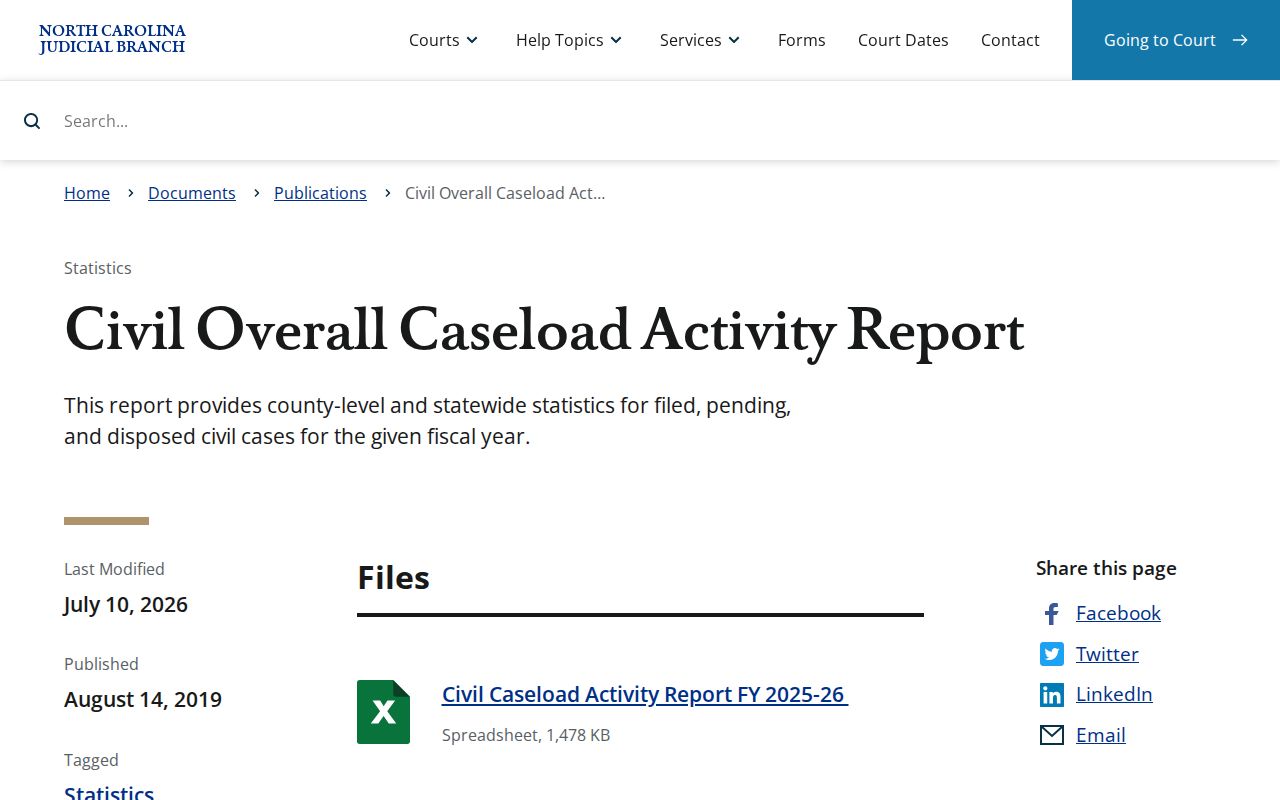
That report offers aggregate context. For the events and settings attached to a particular Lee civil matter, the Case Summary remains the source.
What a Civil Docket Shows
A public Lee civil Case Summary can show a lot. Expect the record number, case type, and status. Also expect parties and attorneys, assignment, cause-of-action information, event history, hearing block, financial information, and disposition. A result may also flag a transfer, an appeal, or trial de novo status. What appears depends on the individual public case. One caution applies. A search result does not guarantee that every attachment or filed document is online.
| Record number | The case identifier needed to distinguish the file and request a particular record from the Lee Clerk. |
|---|---|
| Case type and cause of action | Classification information that may identify the civil, family, probate, or mental-health matter returned by the Portal. |
| Parties and attorneys | Names shown for the public case, useful for confirming that a result is the intended Lee matter. |
| Events and hearings | Register of Actions entries and future-hearing information that may show a filing, notice, motion, order, or reset. |
| Status and disposition | A procedural status and, where available, disposition or financial information; the underlying document controls its precise terms. |
Lee County Civil Docket Court Paths
Court level matters in any civil docket search. Superior Court generally handles civil disputes above $25,000. Under North Carolina's descriptions, District Court generally handles civil cases below $25,000 along with family matters. Magistrates hold jurisdiction over specified small claims up to $10,000 and related matters. Treat these dollar thresholds as guidance only. They cannot classify a specific filing without the court record itself.
| Lee path | General role | First public route |
|---|---|---|
| Superior Court civil | Civil disputes generally above $25,000. | Portal Smart Search, then the Lee Clerk for the case file or copies. |
| District Court civil | Civil disputes generally below $25,000 and family matters. | Portal Smart Search or Search Hearings set to Civil. |
| Magistrate civil | Specified small claims up to $10,000 and related matters. | Portal or Lee Clerk, subject to public availability. |
The statewide jurisdiction descriptions behind this Lee County civil docket split come from the Superior Court and District Court pages.
Types of Civil Cases on the Docket
A Lee civil search can cross several court paths, each with its own public-access limits. Portal guide examples include Civil Foreclosure, Civil General, Civil Magistrate, Confession Judgment, Non-Domestic Restrictive Order, and Summary Ejectment. There is no separately identified Lee probate court. Instead, the Clerk handles estates and special proceedings. Domestic and family matters can carry confidentiality rules or specialized scheduling. Never assume what they will display publicly.
- Superior Court civil disputes generally above the $25,000 threshold.
- District Court civil matters generally below that threshold.
- Specified magistrate small claims within the $10,000 jurisdictional limit.
- Family and domestic matters, subject to their access rules and schedules.
- Estates and special proceedings kept through the Clerk of Superior Court.
Lee County Civil Docket Schedule Divisions
Lee's local administrative materials divide the calendar into Civil Non-Domestic, Civil Domestic Violence, Domestic Motion or Trial, DSS, and IV-D schedules. The 2026 master schedule assigns Civil Domestic Violence to Monday in both paired courtroom tracks, domestic motions to Tuesday A/C, and domestic trial blocks to Wednesday and Thursday. IV-D goes to Friday A/C. Those are genuine Lee calendar details. Still, they describe allocations, not a confirmed time for any individual case. The current Lee local rules and forms page indexes these local materials. They include a Case Status Order effective January 1, 2025 and a domestic calendar request form.
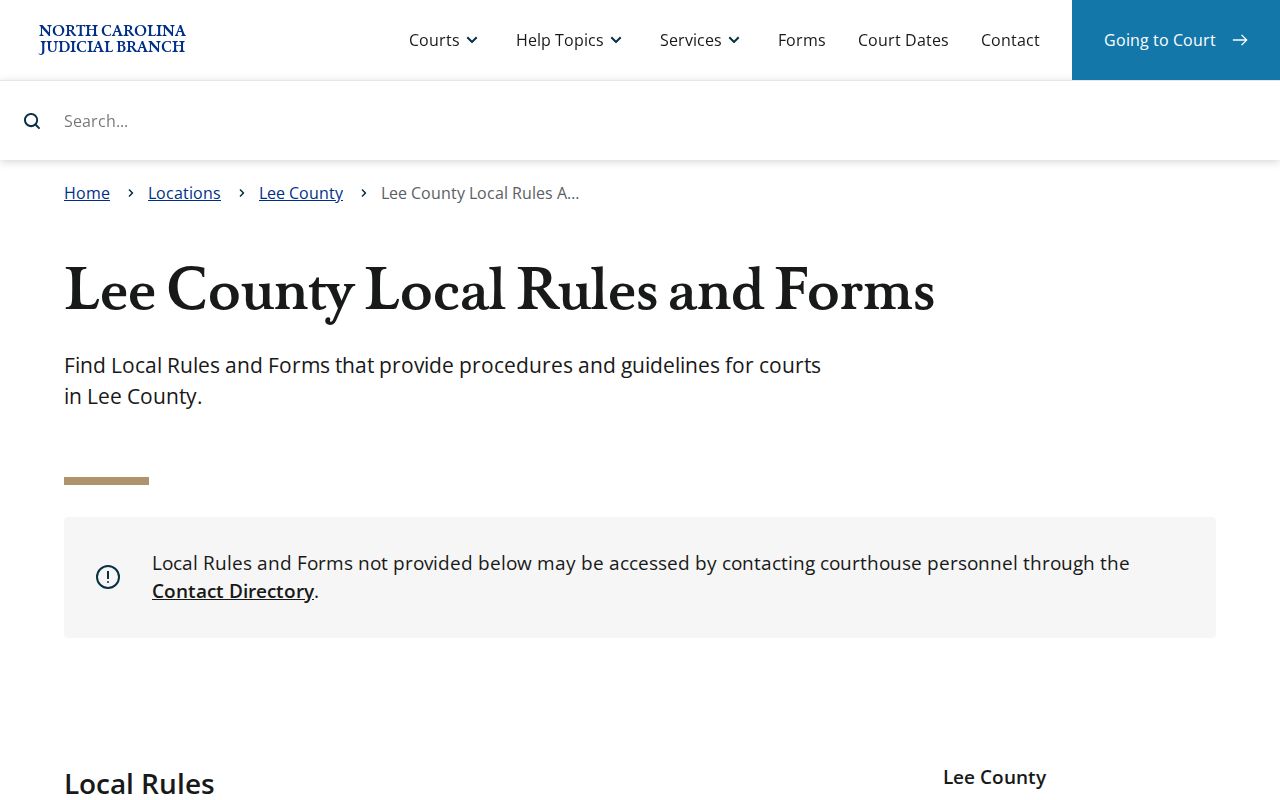
One linked older local-rules PDF describes civil-calendar practices. It carries an older district label, so do not copy a form field or deadline from it. Confirm any current requirement with the Clerk.
Settings and Hearings on Civil Dockets
A civil setting is a schedule entry. It is not a promise. A hearing will not always occur exactly as a general calendar PDF suggests. The older Lee local-rules PDF says the Clerk prepares civil calendars. It also processes trial, hearing, motion, and continuance calendar matters. Timing rules are in there too. Term calendars are prepared four weeks before the session. A party seeking calendar placement normally requests it at least five weeks before a term. To verify a date, check the specific Case Summary and the Search Hearings result. If a setting is time sensitive or unclear, contact the Lee Clerk directly. The local schedule index also lists "none at this time" for Civil Superior. That is one more reason to confirm a particular Superior Court setting rather than trusting an index.
Finding a Lee County Civil Docket Document
A Lee County civil docket entry tells you something happened. A filing, a notice, a motion, an order. What the entry cannot do is quote the document itself. The controlling language sits in the paper or PDF behind the line item. A Portal status never fixes the exact terms of a judgment. A result list also does not promise that every attachment is viewable online.
Want the actual filed order? Write down the Lee record number, name the document, and estimate its date. Ask the Clerk whether you need an ordinary copy or a certified one. The statewide court-records guidance walks through the clerk-terminal, paper-file, and copy routes. One caution applies here. The NCAOC public-records form covers administrative records held by NCAOC. It does not cover a Lee case file.
Public Access to Civil Dockets
G.S. 7A-109 sets the baseline. It gives the public access to clerk-maintained court records during regular hours. That access is subject to statutes, rules, and court orders. The Portal is a handy channel, but it is not the official record. It will not return confidential or restricted information. A public case can still be available through the clerk even when the online view hides documents.
Family and domestic matters may carry access restrictions. Do not assume every case detail is public. If a known record stays invisible, check the name first. Then check the record number and the Lee location. Ask the Lee Clerk what lawful access process applies. Call 919-718-6300, or visit during courthouse hours, 8 a.m. to 5 p.m. on weekdays.
Lee County Civil Docket Clerk and Estates Route
Lee County has no standalone probate court and no separately elected probate clerk. Estates and special proceedings run through the Lee County Clerk of Superior Court instead. That unified structure matters. It applies whenever a Portal result touches probate, a special proceeding, or a civil matter that skips the usual Superior or District labels.
For ordinary public copies, give the Clerk the court. Provide the record number if you have it, party or caption details, the record you want, and whether a plain or certified copy is required. G.S. 132-6.2 permits practical copy requests and sets authorized costs. It does not override confidentiality, sealing, or a court order. The Lee Clerk offers no online form, fax channel, blanket turnaround time, or ID rule for ordinary public copies. Ask directly.
Lee County Civil Docket Case Status Order
The current Lee local-rules index lists a Case Status Order effective January 1, 2025. Its existence is a local reminder. Case-management directions can matter as much as the Portal event list. A docket entry proves something was filed or entered. It shows nothing more. The order itself controls its terms and any current obligation.
Pull up the local-rules page for the current material. Then verify the relevant filing or order through the Case Summary and the Clerk. The linked documents carry the actual fields, deadlines, and requirements for the particular civil matter.
Lee County Civil Docket Copy Choices
Three answers, three questions. A Case Summary, an ordinary copy, and a certified copy each do a different job. The Portal shows a public view of a case and its visible entries. An ordinary copy reproduces a public item. A certified copy carries the Clerk's authentication. An official record calls for clerk certification. A printed portal view will not replace it.
Ask the Lee Clerk which form fits your need before requesting it. Confirm the current fee and turnaround at the same time. Keep the Clerk's case-file route separate. Keep it apart from NCAOC administrative public-record requests. Lee provides no single online request form for ordinary court-file copies.
Lee County Civil Docket Superior Court Check
For Superior Court civil matters, the local schedule index says "none at this time" for Civil Superior. Read that carefully. It is not a finding that your case has no setting. It is not proof that Superior civil records are unavailable either. It simply means a case-specific check beats the schedule index alone.
Search the public Case Summary by the Lee record number. Use Search Hearings when an upcoming date is at issue. Call the Clerk if the result leaves the question open. That sequence keeps the statewide Portal, the local calendar, and the records office each in their proper roles.