
How to Search the Sanford Court Docket
There is no standalone Sanford docket search. Every Sanford-origin case that enters Lee County court lives in the state system. Open the North Carolina eCourts Portal. Use Smart Search with a record number or a name. When the live control is available, the advanced flow also accepts a Citation Number. If a Sanford name pulls statewide results, set Lee County as the location filter. That cuts the noise.
- Read the citation or notice for a record number, citation number, date, and court instruction.
- Search the eCourts Portal with the record number or a name, then open the returned Lee case.
- Use the citation number through the Portal's Citation Number route when the live form offers it.
- Use Search Hearings with Lee location and a date range to locate an upcoming setting.
- Use the Lee Clerk terminal, counter, or 919-718-6300 when the record needs confirmation or a copy.
No city office takes the place of the Lee Clerk as custodian of the record. The Portal is only an access view. Certified copies and questions about restricted records go to the clerk.
Once a primary search value is in, tighten Portal results with the Lee location. Add any case-type or status filters the screen offers. Advanced filtering cannot run by itself, per the official guidance. A name search alone may return a short list. A record number or citation number identifies the correct court matter far better. One caution applies. A restricted record can stay off the public route even when another lawful access process exists.
Sanford Citation Route to District Court
Traffic, misdemeanor, and ordinance prosecutions in Sanford begin in Lee County District Court, not a city court. G.S. 7A-272 gives District Court original jurisdiction over criminal actions below felony level, municipal ordinance violations included. Local enforcement may start things. The Lee state-court system then receives the court case.
That split solves a common search problem. A City Hall contact, police incident number, or code notice can identify the local matter, yet the docket exists only once the matter takes the court route. Search the citation or Lee record number itself. A city court portal is not listed among the official sources.
The Sanford Municipal Court
Sanford's official sources list no separate municipal court. The same goes for a municipal-court judge, a municipal-court calendar, and a city citation-payment tool. Traffic, misdemeanor, and ordinance prosecutions route elsewhere. They go to Lee District Court. The eCourts Portal is the public route to those case records. The Lee County Clerk of Superior Court keeps the court records.
The municipal-court label can send a record search in the wrong direction. City Hall at the county seat is not the court destination. For a court date, a filing, or a certified document, rely on the Lee court and clerk framework. Skip the assumed city-court office.
Sanford P2C Reports Are Not Dockets
City Police enforces ordinances and North Carolina law. It never holds the case that follows. Try the Sanford Police Department at 919-775-8268 for a nonemergency, city-side contact. That works for questions about how an enforcement action began. It will not confirm a court setting, a court balance, or a certified court record.
Under the City's P2C report notice, accident, incident, and arrest reports are available with a case number. The wait runs approximately 48 hours. Remember what a P2C report is. It is a police-record channel. It is not a Case Summary, a Register of Actions, a payment route, or a court docket.
The Sanford Police page lists city services and contacts. That covers the enforcement side of a Sanford matter.
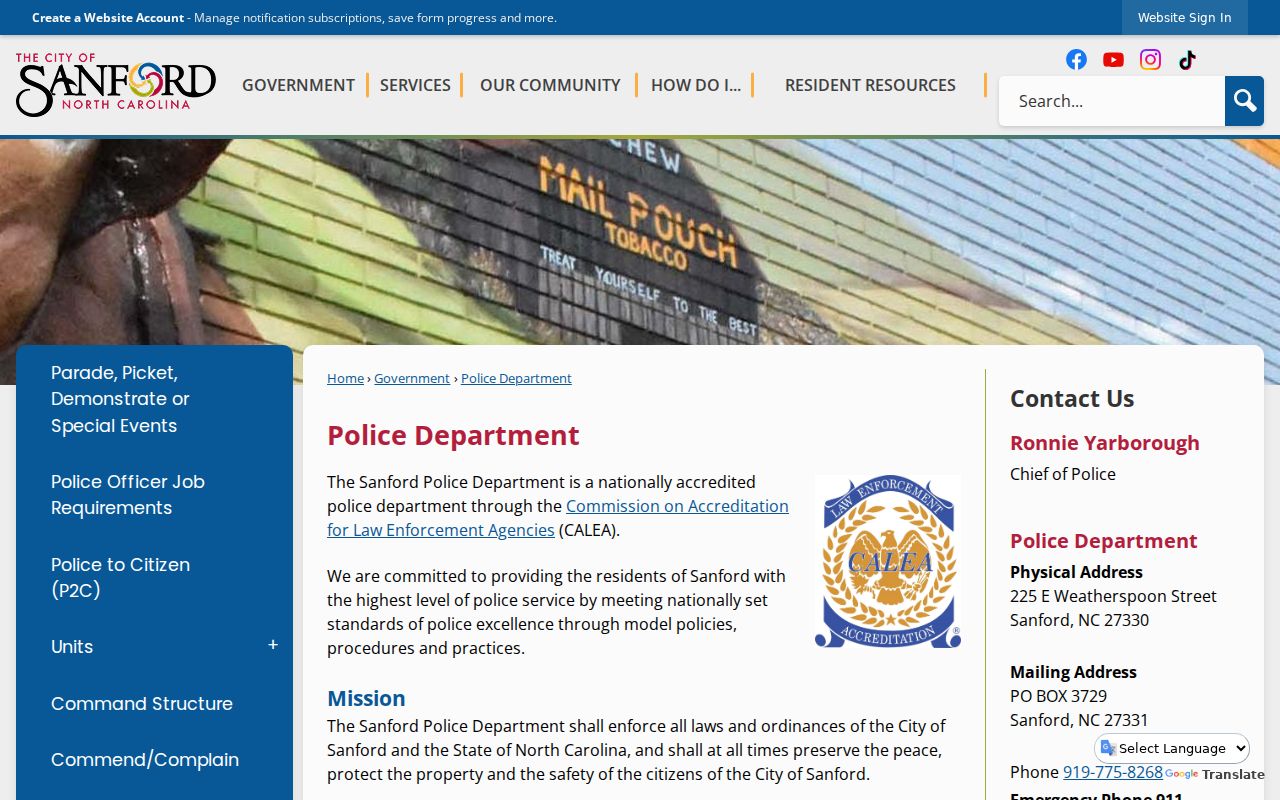
That police page shows where an enforcement contact may begin. Lee court records themselves stay with the Clerk and the Portal.
Sanford Court Dates and Settings
A citation should state a court date. Still, check any upcoming setting in the Lee case record itself. The Portal offers a Search Hearings function. It works with a Lee location, hearing type, search relationship, and date range. A schedule is only an allocation guide. Confirm a time-sensitive setting with the Lee courtroom or Clerk.
| Record or citation number | Use the notice number or the Lee record number returned by the Portal. |
|---|---|
| Location | Confirms the Lee County court location for the Sanford-origin case. |
| Hearing date | Use the case-specific date, which can change after a reset or order. |
| Hearing type | Search Hearings can identify a listed civil, criminal, family, probate, or mental-health category. |
| Courtroom | Available where shown; verify a court appearance with the courtroom or Clerk. |
| Status | Read the dated Register of Actions with the current setting or disposition entry. |
The Lee local administrative schedules add court-calendar context for Sanford matters. They cannot substitute for a case-specific hearing result. Use the case number when you can, since it anchors any Sanford hearing search. If results run broad, the Lee location and date range narrow them. Keep the citation and any later notice. Hold them until the Lee setting is confirmed.
Sanford Disposition Court Contest Path
A minor Sanford traffic matter set in Lee Administrative Traffic Court moves to Disposition Court. Local notice puts that court's hours at 9 a.m. to 4 p.m. on the scheduled day. It is not a trial. The officer is not present. A Sanford reader may appear in person during that window, or send an attorney.
To contest a Sanford citation or plead not guilty, appear yourself or have counsel appear. That step lets a later officer-present court date be set. Eligible payment is a separate path. For the full county process, including payment and copy options, see the Lee County traffic court records reference. It covers those options in detail.
Sanford court-date point: Disposition Court resolves minor traffic matters or sets the next court event. It does not supply a city-court trial date.
Sanford Traffic Tickets
A Sanford traffic ticket lands on the Lee District Court docket. Start with two things from the citation: its number and the court date. Then search the Portal or the Lee Clerk for the Sanford-origin case. Sanford itself hosts no ticket lookup or payment portal. Eligible online, counter, telephone, and qualifying mail payments all run through the Lee payment page.
Pay only if the case screen shows the payment is allowed. To contest the ticket, take the appearance route instead. Suppose the ticket has not shown up online yet. Keep the printed court date. Call the Lee Clerk too, because an early empty search is not a final answer.
Hold onto the Sanford citation along with the court notice. Before responding, match any search result to the Sanford date and record number.
Sanford Code Notices and Court Boundaries
Sanford code enforcement is an administrative process, not a municipal-court docket. The Sanford Code Enforcement office handles public nuisances, health and fire hazards, nuisance vehicles, property-maintenance standards, and zoning or community-development enforcement. A code notice by itself creates no court record.
The joint Sanford/Broadway UDO Article 1 lays out the timeline. A nonemergency violation normally gets 10 days to correct. After that, a $100-per-day civil penalty starts. If a matter stays unresolved after 30 days, Lee County may pursue the penalty and costs in District Court as a debt action. Repeat Sanford violations can carry a shorter cure period.
A code contact and a court case are different records. An administrative notice becomes a docket search subject only through the documented Lee court route.
The Code Enforcement office sits at 115 Chatham St., Sanford, NC 27330. It is reachable at 919-718-4652 ext. 1405. Staff there can explain the City compliance process. They cannot confirm a Lee courtroom setting or issue a certified court record. The line matters. A code notice can stay administrative through the whole correction period and never reach a docket.
The Sanford City Hall page offers city context, not a Sanford court address.
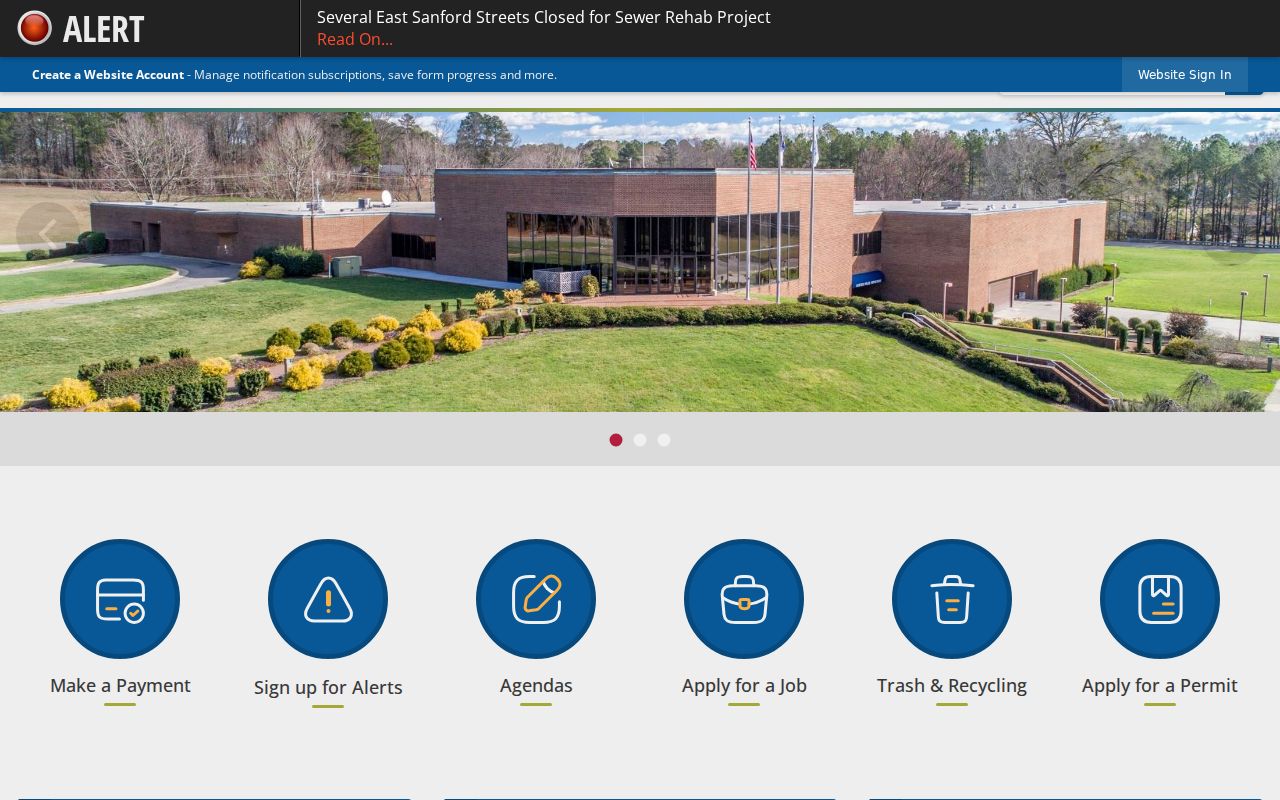
Sanford City Hall covers municipal services and code contacts. Court records take the Lee courthouse and Clerk route instead.
Where Sanford Cases End Up
A Sanford-origin court matter moves through the state court system. Local traffic, misdemeanor, and ordinance cases start in Lee District Court. The Lee Clerk and eCourts Portal handle the public case route. Superior Court only enters the picture on appeal. That happens when an eligible District Court criminal conviction is appealed for a new trial.
Docket flow: Sanford enforcement or citation → Lee District Court → Lee County Clerk of Superior Court / eCourts Portal → Lee Superior Court only in an eligible appeal for trial de novo.
A Sanford civil code action, when pursued, also runs through the Lee court framework rather than a city court. For the wider structure, see the Lee County court docket overview.
Sanford Appeals Reach Superior Court
A qualifying Sanford-origin criminal case decided in District Court can be appealed to Lee Superior Court for trial de novo. G.S. 15A-1431 sets the general 10-day notice-of-appeal rule. It also gives qualifying District Court criminal appeals their new-trial character. It creates no Sanford appellate office and no city court layer.
"Trial de novo" means the case is tried anew in Superior Court. It is not a rereading of a Sanford city docket. Sanford readers should use the Lee case record to find the actual entry. They can ask the court for direction on an active matter.
An appeal entry lands in the Lee case history. So a Sanford court search should follow the record number through the later court event.
Public Access to Sanford Court Records
Sanford court records flow through the Lee Clerk and the public eCourts route. North Carolina access limits still apply. A public case can be inspected on the Portal or a clerk terminal. A precise request can seek a plain or certified copy from Lee. No Sanford city office holds the court record. Restricted, juvenile, sealed, or confidential matters may not show in a public result.
North Carolina access rules:
G.S. 7A-109 requires clerk-maintained dockets and indexes and establishes public inspection unless another law provides otherwise.
G.S. 132-6.2 addresses copies, costs, and requested media; it does not require a custodian to create a new record.
G.S. 7B-3000 limits public inspection of juvenile records.
To request a Sanford case copy, give the Lee Clerk the court and the record number if known. Add party or caption information, the document or event, and an approximate date. Say whether certification is needed too.
Requests work best when they name one case and one document or event. The Lee Clerk can tell the difference. A Sanford public Portal view is not the official court file. The Clerk can explain more. Ask about the lawful route for a record that is not visible online. That clarity keeps a city-side contact from being mistaken for a records-office answer.
The Sanford Clerk first locates the file. Then a plain copy and a certified copy are different requests. State which form you need early.
Sanford Enforcement Context Not Court Outcomes
Sanford is Lee County's largest incorporated place. The OSBM Vintage 2024 municipal data puts its estimated population at 32,813 residents for July 1, 2024. That scale explains why city-service and police contacts are common first stops. It says nothing about Sanford court filings, case outcomes, or any municipal-court caseload.
The numbers grow from there. Sanford's FY2025 ACFR counts 1,725 traffic violations, 277 parking violations, and 1,303 physical arrests as City Police activity measures. Treat these as enforcement counts, plain and simple. They are not Lee court outcomes or dispositions. No separately listed Sanford municipal court exists. The public court-record route still runs through the Lee Clerk and the eCourts Portal.
Note: Sanford local activity figures describe City operations. They cannot be used to estimate an individual court case or future court calendar.